
Research diplomacy in action: the debate on a united Ireland

The renewed, post-Brexit, debate on possible referendums on a united Ireland is a good example of research diplomacy in action, writes John Doyle. Faced with an unanticipated and highly sensitive constitutional question, researchers mobilised across borders and communities to generate new evidence, and their ongoing work is now making a positive contribution to post-conflict diplomacy on the island.
The 1998 Good Friday peace agreement provided for referendums in both parts of Ireland and committed the UK Government to facilitate unification if both referendums passed. It was widely assumed that such change would be in the future, and that the post-Agreement priority would be a power-sharing model of government, improved equality inside Northern Ireland and greater cooperation and open borders between the two parts of the island.
Brexit radically changed the political dynamics on the island. The form of Brexit chosen, with the UK outside the EU customs union and Single Market, turned the land border on the island of Ireland, from one which was fully open after the 1998 Agreement, into an EU external frontier. This raised the possibility of physical customs and security posts, disrupting the open border foreseen in the Good Friday Agreement, imposing significant social and economic costs on communities along the border, and raising the fear of renewed violence.
A majority of the population of Northern Ireland had voted to remain in the EU, but this majority had a local political context. Supporters of Irish unity, and the political middle ground voted overwhelmingly to stay in the EU, while 66% of unionists (supporters of Northern Ireland remaining in the UK) voted to leave. As the UK pursued a ‘hard’ Brexit, it became clear that, politically, the situation on the island could go into reverse and that Northern Ireland’s concerns had little impact on UK Government policy.
In response, calls grew for earlier referendums on Irish unity. This was primarily about protecting the peace process, premised on an open border on the island, but unity would also bring Northern Ireland immediately back into the EU, which was a crucial issue for the political centre as well as supporters of unity.
Yet there was very little clear evidence on the implications of unity in practice – for the economy, healthcare, education, human and minority rights, political institutions and the process itself. The UK Brexit referendum had shown the risks of asking a profound constitutional question without a clear evidence base. Across the island, there was a near consensus that no similar referendum should be held on unity without a very detailed plan for a new and united Ireland, covering both the process and all key areas of public policy, and published well in advance. But the evidence needed for such a plan was barely available.
From 2020, a group of academics came together to address the need for evidence. They created ARINS (Analysing and Researching Ireland North and South), a network supported by the Royal Irish Academy and the University of Notre Dame in the USA. Participants deliberately had no agreed view on whether a united Ireland should be created or not. What they shared was the view that detailed peer-reviewed research on all options and all implications needed to be carried out and published. Those involved, as authors and advisors, were from the two parts of the island, Britain and beyond, and this was a crucial strength of the project.
Since 2021, over 2 000 pages of peer-reviewed articles have been published in open access format, combined with short blogs, podcasts, seminars, and a book by two journalists summarising the state of play. Where topics were controversial, or results uncertain, multiple papers were published or response articles commissioned. The podcasts, and seminars with politicians and policy-makers, debated the implications of the research.
The research has covered the case for planning, options for managing the process itself and public deliberation, the potential cost of unity, identity issues and European dimensions, and the comparative performance of public services in the two jurisdictions. We now have much clearer comparative data on the socio-economic situations in the two parts of the island, showing for example that the Republic is wealthier than Northern Ireland, with higher average standards of living, and with much stronger results in areas such as education, welfare, equality and health.
The evidence is already feeding into politics. Opinion polling and experimental deliberative research have improved understanding of public attitudes and priorities, including a large group of undecided voters in Northern Ireland who want more information before making up their minds. Civil society groups are calling for inclusive debate and do not want to be presented a top-down plan. Irish parliamentary committee hearings on the research findings have also influenced the political process. In July 2025, an all-party parliamentary committee in Dublin, drawing on this body of work, called for government preparations for a united Ireland to begin ‘immediately’.
Much remains to be done, from economic and political design to policy issues such as climate change, biodiversity, security and defence. But the transnational nature of the research, its rigour, its approach to open data and debate, and in particular the early timing of the research, well before the heat of a referendum campaign has already had a positive impact in reducing the possibility of a future Brexit-style referendum being dominated by misinformation, or unevidenced claims. In that sense, the united Ireland debate shows how research diplomacy can support post conflict reconciliation, democratic choice and Europe’s broader commitment to peace based on knowledge.
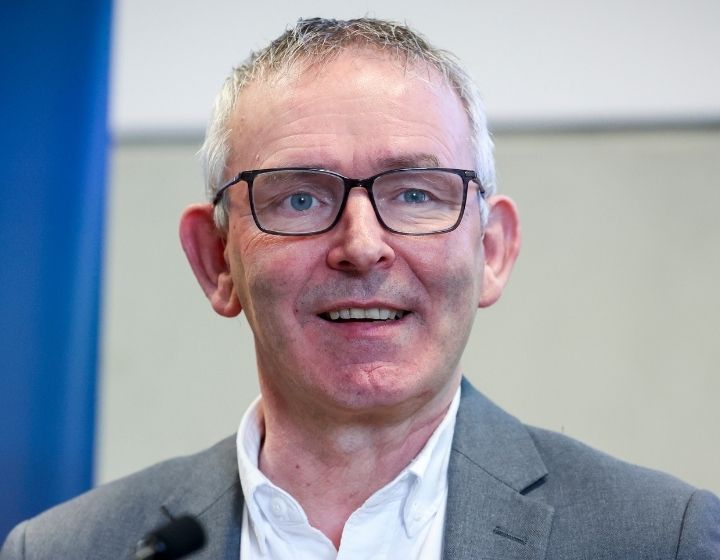
© DCU/Kyran O'Brien
Professor John Doyle is Vice President for Research in Dublin City University and one of the commissioning editors for ARINS research papers. He is author of Before the Vote: planning for a united Ireland (DCU Press, forthcoming October 2026).