
Who controls the science of the high seas?

When diplomats finalised the UN’s landmark BBNJ treaty on high-sea biodiversity, it was widely hailed as a triumph for marine conservation. For Alice Vadrot, it also reveals how science and diplomacy have become inseparable and how knowledge itself now functions as a negotiating tool.
In a UN conference room, delegates argue over brackets and commas in a treaty that will shape the future of the oceans. Around them, advisers shuffle notes, observers watch quietly from the back rows, and side events spill over into hurried corridor conversations. Among the observers sits political scientist Alice Vadrot, filling her notebook as she follows, line by line, how science is used – and contested – in the making of the new High Seas Treaty.
From her seat at the back of the room, she watches how often negotiators reach for scientific language. Provisions on marine protected areas, environmental impact assessment and technology transfer draw on decades of ocean research, and many scientists joined national delegations, spoke at side events, wrote policy briefs and fed into expert networks.
Yet this expertise, Vadrot argues, was channelled in a fragmented way that made it easier for politicians to politicise science, cherry pick numbers or turn uncertainty itself into a negotiating tactic. Side events became the most visible interface between science and diplomacy: intense two-hour sessions in the middle of long negotiating days, where researchers presented analyses, scenarios and potential effects of different treaty options. ‘There was a lot of scientific input,’ Vadrot notes, ‘but science was not only there to guide decisions. Science itself was at stake.’
Science, access and inequality
One of the more subtle dynamics in New York is that the treaty not only regulates biodiversity; it also reshapes marine scientific research. ‘Science depends on access to areas, on permits, on data sharing obligations', Vadrot explains. ‘So, science was, in a way, negotiating for itself.’
She sees a clear divide here. Many governments from the Global North focused on protecting freedom of scientific research and were wary of ‘bureaucratising’ research on the high seas through new procedures and controls, particularly in international waters. For them, the outcome largely preserves the status quo by avoiding heavy new layers of regulations on researchers.
For many countries in the Global South, the core concern was different. They were less worried about new red tape than about gaining the capacity to do research at all: ships, instruments, trained people, access to data and samples. ‘These needs – the ability to conduct research in and on the high seas – are far from being fully addressed,’ Vadrot says.
The same tension shows up in how far governments were willing to follow where science leads. Modern oceanography reveals cumulative impacts across sectors, deep ecological connectivity, and the limits of managing the sea by rigid zones and fragmented mandates. Taking that knowledge fully seriously would imply ‘rethinking and transforming ocean governance,’ she argues – including maritime zones, responsibilities and the way we exploit resources.
‘But governments were not willing to open that box,’ she says. ‘Legally, BBNJ is framed as an implementing agreement under UNCLOS (The UN Convention on the Law of the Sea), and states kept saying it cannot undermine that framework. Science, however, suggests we may need a different system altogether. When UNCLOS was negotiated in the 1960s and 1970s, little was known about the deep sea; today, a wealth of data shows there is life there that we need to care about.’
Power in data
With her ERC Starting Grant, MARIPOLDATA, Vadrot set out to study these tensions empirically. Her team combined collaborative event ethnography at the BBNJ negotiations with a systematic analysis of the marine biodiversity research and interviews with scientists around the world.
‘We wanted to know not just how treaties are negotiated, but how power in diplomacy is linked to who produces and controls knowledge,’ she explains. Their bibliometric analysis revealed a stark pattern: most literature, data and infrastructures are concentrated in the Global North, particularly the United States, parts of Europe and Australia, while researchers from the Global South struggle with access to data, funding and ships – yet are expected to sign up to the same rules.
These inequalities run through the treaty politics. ‘Governments from the North primarily pushed for a conservation treaty: strong provisions on marine protected areas, tools, and environmental impact assessments,’ Vadrot says. ‘Governments from the South accepted this only because the package also contained capacity building, knowledge transfer and benefit sharing from marine genetic resources.’ That trade-off – conservation tools versus fair access to knowledge and benefits – became one of the clearest North-South fault lines.
Another flashpoint was the ‘common heritage of humankind’ principle. In ocean law, it currently applies to minerals in the seabed. Many developing countries wanted to extend it to the water column and living resources in areas beyond national jurisdiction. ‘This debate ran right to the end,’ recalls Vadrot. ‘It was about justice, about who benefits, but also about different visions of what the ocean is and how it should be governed.’
Turning UN talks into data
Following the negotiations in this detail required new methods. A conventional lone ethnographer could not capture everything happening in the UN conference rooms. Using ERC funding, Vadrot built a team and designed a shared digital note-taking tool so that several researchers could record sessions in parallel and still produce a coherent dataset.
They worked closely with the UN Secretariat to make sure their presence did not disturb the talks and to address ethical concerns. ‘Trust was absolutely crucial,’ Vadrot says. ‘We anonymised about half of the dataset, removed personal names from informal settings, and involved both students and diplomats in giving feedback before publishing anything open access.’
The result is MARIPOLDATAbase, an openly available resource that traces who said what during key phases of the BBNJ negotiations. Delegations have already used it to recall the context behind specific phrases in the treaty text, and representatives of the G77 – a coalition of developing countries at the UN – and China have engaged with the team’s analyses of contentious concepts such as the ‘common heritage of humankind’.
At home in Austria, a landlocked state with a long history in ocean diplomacy, Vadrot and her team also used their findings to foster dialogue. They organised informal workshops for officials from the foreign and environment ministries, brought together diplomats, scientists and legal experts, and even hosted a cinema night featuring a high-seas documentary to support ratification and public engagement.
‘These kinds of initiatives helped us build a very solid basis and credibility, which we then used to facilitate dialogue,’ she says. ‘It is not about steering the process towards a particular treaty design, but about connecting scientists and other relevant voices with decision-makers and creating the space needed to keep up momentum.’
From high seas to digital oceans
Vadrot’s latest ERC-funded project, TwinPolitics, shifts from analogue negotiations to digital oceans. It treats ‘digital twins’ of the ocean – virtual models that integrate vast amounts of data and run scenarios – as political objects, not just technical tools.
‘Ocean diplomacy is only going to get more complex,’ she says. ‘If you want to protect 30 % of marine areas by 2030, or balance offshore energy, fisheries and conservation, you need ways to visualise trade-offs and long-term effects.’ Digital twins promise to help by integrating scattered data streams and simulating what might happen if, for example, a new shipping lane is opened, or a marine protected area is moved.
But the politics of who builds and controls these tools, what data they include, and whose knowledge they encode are just as important as their algorithms. TwinPolitics maps existing digital ocean twins around the world, surveys negotiators about their data practices, and uses ethnography to follow how the EU’s own digital twin is being constructed.
For Vadrot, this is science diplomacy in a very concrete sense. ‘Without science, there would be no climate or biodiversity diplomacy at all – you need scientific understanding to define the problem,’ she says. ‘Today, science is also central to measuring implementation: indicators, stocktakes, monitoring frameworks. That makes scientific choices, and data politics, more contested than ever.’
At the same time, she sees a shift towards broader understandings of what counts as relevant knowledge. Compared to the negotiations she first studied in 2009, there is now more recognition of traditional knowledge, Indigenous perspectives and interdisciplinary approaches. Small island states have become powerful voices defending both their survival and their own ways of knowing the ocean.
‘Science diplomacy is no longer just about ‘speaking truth to power’,’ she concludes. ‘It is about negotiating which truths matter, who gets to speak them, and how we turn them into fair and effective rules for a changing ocean.’
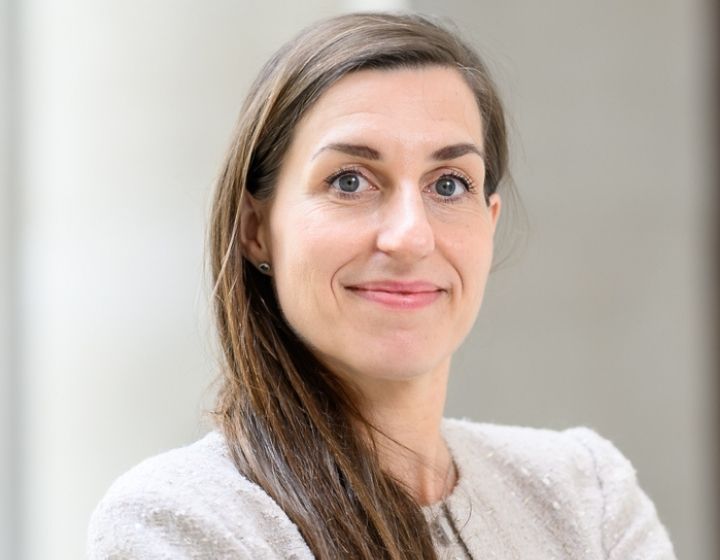
© Uni Wien / Klaus Ranger
Alice Vadrot is Professor in International Relations and the Environment at the University of Vienna