ERC President’s speech on academic freedom under threat
20 November 2025
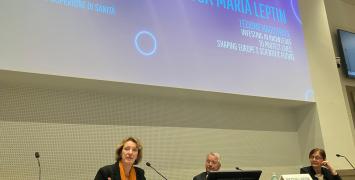
ERC President Professor Maria Leptin gave a speech at the Coimbra Group’s 40th anniversary at Bozar, Brussels

Photo credit
© Maria Leptin
-- Check against delivery --
Dear Prof. Thilly,
Dear Representatives of the Coimbra Group,
Ladies and Gentlemen,
Thank you for the invitation. It really is a pleasure to be here to celebrate forty years of the Coimbra Group. For four decades, this network has stood for the best of the European university tradition: openness to the world, rootedness in cities and communities, a commitment to public responsibility, and a belief that universities matter not only because of the knowledge they produce but because of the values they protect.
The Poitiers Declaration on University-City cooperation was ahead of its time, insisting that universities and municipalities shape their future together rather than in isolation. And the Durham Declaration on climate change and sustainability is another example of foresight - showing that universities can lead not only by educating and researching, but by helping societies rethink their priorities. The Coimbra Group has never treated universities as ivory towers, but as civic institutions grounded in solidarity, inclusion, diversity, human rights, and democratic participation.
This commitment makes the Coimbra Group not only a network, but a community of purpose. So it is a great honour to mark its 40th anniversary with you tonight. Of course we also appreciate very much the Coimbra Group’s strong commitment to strengthening education, research, and innovation at the EU level and in particular your staunch support for the ERC over the years.
Like you, the Scientific Council of the ERC broadly welcomes the Commission’s proposals for the next EU Multiannual Financial Framework, especially in terms of funding. But also like you and other parts of the scientific community we await clarity and reassurance on some of the details. The European Commission has fulfilled its promise to expand the ERC by proposing a €31 billion budget, up from €16 billion now.
For the ERC, this level of increase would allow us: to fund all of the excellent proposals that we currently receive; to increase the level of the grants to account for inflation; to continue the recently announced ERC Plus grants; and possibly to finance new schemes such as the ERC for Institutions (ERC-I) proposed in the Mario Draghi report on EU competitiveness.
However, even with the proposed budget increase for the ERC, policy makers and stakeholders should be realistic about the ability of the ERC to develop new funding schemes and take on new responsibilities given the effects of inflation and current rates of oversubscription to the ERC’s existing calls, as well as rising applications.
The proposals maintain the ERC’s mission to support curiosity-driven frontier research across all fields, based only on scientific excellence and maintain most of the Scientific Council’s unique roles and responsibilities from previous framework programmes.
However, the Scientific Council still has concerns over its ability to oversee the implementation of the programme, as well as questions about specific changes proposed to the legislation by the Commission, especially regarding the Scientific Council’s roles and responsibilities.
Ideally, the Scientific Council wants to see the ERC’s existing governance arrangements overhauled in order to future proof its independence, reward its success and signal Europe’s commitment to scientific freedom.
And this brings me to the theme of tonight’s event. Because it seems we can no longer take for granted our academic and scientific freedoms.
The invitation to reflect on enduring values comes at a moment when universities are facing mounting pressures. Tonight I want to speak about one value that underpins all others: academic freedom — and why defending it matters for the future of excellent research across all disciplines.
Academic freedom is under threat
Freedom, in all its dimensions, is a core European value and right. The freedom of research is vital for fostering innovation, expanding knowledge, and securing Europe’s future in times of division. Today, our continent faces complex challenges – ranging from political polarisation and geopolitical tensions to economic disparities and environmental divides.
Is scientific freedom in Europe under threat? I would like to start with some quotes on the nature and necessity of scientific freedom. Article 5.3 of Germany’s constitution states simply that: “Arts and sciences, research and teaching shall be free.”
Vannevar Bush wrote in 1945: 'Scientific progress on a broad front results from the free play of free intellects, working on subjects of their own choice, in the manner dictated by their curiosity for exploration of the unknown. Freedom of inquiry must be preserved under any plan for Government support of science.'
The Kalven Committee added in 1967: 'To perform its mission in the society, a university must sustain an extraordinary environment of freedom of inquiry and maintain an independence from political fashions, passions, and pressures. A university, if it is to be true to its faith in intellectual inquiry, must embrace, be hospitable to, and encourage the widest diversity of views within its own community.'
I believe that these ideas and principles from both sides of the Atlantic put the case for scientific and academic freedom more powerfully than I ever could.
But sadly we were mistaken if we though these principles would remain unchallenged.
And while explicit government attacks on science and universities that we have seen from the current US administration and takeover of science institutions like in Hungary remains rare in Europe, challenges such as funding instability, politicised promotions, limitations on mobility and increased populist scepticism toward science are growing trends in other parts of Europe.
We have even seen an extraordinary example of a campaign of harassment and intimidation directed at a UK university by Chinese authorities… who demanded that research on human rights being done in Sheffield be halted.
So, I think the political threat to scientific freedom, what we might think of as active suppression, does represent a clear and present danger which we must be aware of. However, there are other, more subtle threats, what we might think of as passive suppression, which we should not ignore.
Scientific freedom is not a single right. It is a set of conditions that allow scientists to work with honesty and imagination. It includes the freedom of institutions to organise their affairs without political interference and to teach and publish without fear. But it also includes the freedom to choose one’s own questions and to share knowledge across borders. And there is another kind of freedom that is rarely mentioned, the freedom that comes from material security. A researcher on a short-term contract and only short-term funding - and therefore with no time to think or experiment - is not free in any meaningful sense.
When people talk about a crisis of freedom, they often mix these things together. But to me these are very different issues, and if we treat them as one, we risk producing a confused response.
Why we need the humanities and social sciences to protect democratic values
When we think about the impact of science we tend to think of discoveries in the natural sciences and the technologies that have arisen from those discoveries. Yet, much of what defines the modern world was not discovered in laboratories at all.
For better or worse, the ideas of Marx, Weber, Schumpeter, Freud and Keynes have shaped our economies, institutions, and even our private lives as profoundly as any observation of Darwin, equation of Einstein or experiment of Bohr.
Science and technology transform the material world, whilst the social sciences and humanities transform the way we live within it.
We also need to consider what we might call social technologies - inventions made of institutions, rules, and shared understandings rather than machines. The rule of law, trial by jury, and independent courts are social technologies: they make cooperation possible by replacing personal authority with predictable rules. So are money, credit, and insurance, which turn trust and risk into calculable forms. The joint-stock company, the pension system, and the constitution are all designed systems that allow large societies to function.
A social technology is a human solution to a coordination problem. It is as much a product of creativity and experiment as an engine or a vaccine. Double-entry bookkeeping made modern capitalism possible, statistics made welfare policy feasible, peer review and universities are technologies for producing reliable knowledge. Even the idea of 'scientific method' is itself a social technology, a set of agreed procedures for deciding what counts as evidence.
These examples remind us that discovery is not confined to the physical world. It also happens in how we order our societies.
Richard Feynman once said that scientific knowledge is an enabling power to do either good or bad - but it does not carry instructions on how to use it. Those instructions, he added, must come from elsewhere.
The ERC has always understood this. Some of its most original projects come from the social sciences and humanities… These are not marginal to innovation, they are part of its foundation.
To understand human values, we need disciplines that study humans in all their variety, their institutions, beliefs, and contradictions. The humanities and social sciences do not promise comfort, they aim for understanding. And understanding is what allows knowledge, of every kind, to serve society.
Curiosity-driven research is how societies stay adaptable
Research driven by curiosity - rather than by predefined agendas - is one of the strongest safeguards of academic freedom and democratic resilience.
There is a growing tendency to treat the social sciences and humanities as useful only when they help achieve predefined goals. If we only value scholarship when it serves an agenda, we lose the freedom to ask the questions that might matter most.
Curiosity-driven research is often described as a luxury, something that can wait until urgent problems are solved. In truth, it is how we find out what the real problems are. Without that space, we solve the wrong problems with great efficiency.
The ERC was created to defend this freedom, to give the best minds room to think independently, across all fields. The principle applies equally to a physicist exploring the structure of matter and to an anthropologist studying migration or an economist rethinking inequality.
Sometimes that freedom produces uncomfortable results. Research that questions prevailing assumptions is rarely convenient, but it is what keeps societies adaptable.
Conclusion
The Coimbra Group has spent forty years demonstrating that universities do not serve democracy by avoiding difficult issues, but by confronting them. That only works if scholars, students, and institutions are free - free to disagree, to explore, to criticise, and to imagine alternatives.
Curiosity, autonomy, diversity of viewpoints, and the courage to ask uncomfortable questions are not obstacles to progress. They are the conditions of progress.
So let me close with a simple message on this anniversary:
If we defend academic freedom, then excellent research will defend us - not only by producing discoveries, but by strengthening the human values that allow societies to hold together in times of uncertainty.
Thank you, and congratulations again on forty years of the Coimbra Group.