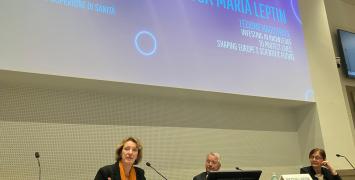
ERC President’s speech at European Parliament - ITRE Committee

Check against delivery
Dear Chair, Dear Members,
Thank you for the invitation.
As you know, the European Commission’s proposal for the next long-term EU budget, MFF, includes a substantial increase for the Framework Programme Horizon Europe and for the ERC. That matters. It signals that research and innovation are being taken seriously in the topical debate on Europe’s competitiveness.
But I need to say clearly that the budget that is on the table should be seen as the minimum, not as a final ambition.
There are a few reasons for that.
First, we are already falling dangerously behind our competitors.
Today, global R&D spending stands at around EUR2.5 trillion. The United States invests about EUR711 billion per year. China invests around EUR675 billion. The EU invests about EUR438 billion[1]. So, we are already operating at a significantly smaller scale than our two main competitors.
If we look at researchers, China has roughly 3 million full-time equivalent researchers. The EU has around 2.2 million. The US about 1.6 million. But what is particularly striking is expenditure per researcher. In the EU, we spend roughly EUR 198,000 per researcher. In the US, the figure is over EUR432,000. That gap translates directly into capacity, infrastructure and long-term output. If we increase modestly while others continue at that scale, the gap does not close. It widens.
The big five US tech companies alone (Amazon, Alphabet (Google), Meta (Facebook), Apple and Microsoft) spend well over EUR200 billion per year on R&D, more than all EU governments combined[2].
And please do not tell me that China only imitates. That might have been true 15 or 20 years ago. It is not true anymore. If we look at the Nature Index, which tracks high-quality publications in leading scientific journals, China now leads globally in output and nine of the top ten institutions are Chinese[3]. If we look at ASPI’s Critical Technology Tracker, China’s global lead extends to 37 out of 44 technologies that ASPI covers across a range of crucial technology fields spanning defence, space, robotics, energy, the environment, biotechnology, artificial intelligence (AI), advanced materials and key quantum technology areas [4]. The shift has been extraordinarily rapid. This is no longer incremental catching-up. China is starting to dominate.
Second, when talking about a long-term budget like the MFF we must take inflation into account.
Using the Commission’s own deflator, a euro in 2034 will be worth around 18% less than a euro in 2025. Keep in mind that the ERC has also not adjusted its grants for inflation since it was created in 2007! In real terms, our purchasing power has already eroded significantly. A nominal increase that does not fully compensate for inflation is not a real increase.
Third, we are struggling to keep up with demand.
The ERC consistently receives more proposals of excellent quality than it can fund. A significant share of projects that pass our highest scientific threshold remain unfunded purely for budgetary reasons. These are not marginal proposals. They are internationally competitive ideas that we simply cannot afford. When we leave excellent science unfunded, we lose future companies, future technologies, and future talent. And applications to our calls are surging. So it's not that we don't have the ideas, we just don't have the money to fund them!
Finally, there is also a political reality we all know. Historically, the Commission’s budget proposals are reduced during negotiations. If that happens again, the signal will be clear - Europe speaks about competitiveness but hesitates when it comes to sustained investment.
I would plead with this Committee to help avoid that outcome.
Investing in a geopolitical world
Let me address another point. There is a narrative that, in a geopolitical world, we need to prioritise applied instruments and industrial policy. I understand that argument. We all see the pressures Europe is under.
But we should be careful not to create a false hierarchy between frontier research and innovation. If Europe invests less overall than its competitors, then the quality of our spending matters even more. Frontier science is the upstream driver of everything else. It feeds applied research, industrial innovation, and long-term competitiveness.
The ERC is not a risky experiment. It is one of the most extensively evaluated and internationally benchmarked research funding instruments in the world. It selects purely on scientific excellence, through global peer review. It has delivered Nobel Prizes, breakthrough discoveries, and companies that did not exist when the grants were awarded. It is predictable in one important sense - you know what you are buying. You are buying the best ideas, selected independently, with no political interference.
If evaluation criteria are rewritten primarily to align with current strategic narratives, independence weakens. Autonomy in selection protects unpredictability. It allows a system to back ideas whose value is not yet obvious.
This is one reason why institutions such as independent research councils matter. They create a buffer between political priorities and scientific judgement. That buffer does not remove accountability. It creates distance from daily pressure. The ERC was built on that principle. Its task is not to select topics that fit a mission. It is to identify researchers with strong ideas and give them time and resources. Its value lies in that simple focus.
So we cannot say that funding frontier science is risky, while funding innovation and industry is guaranteed to deliver. Start-ups are inherently risky. Industrial projects can fail. New instruments take time to get up to speed and do not always deliver. We have seen high-profile failures in Europe when large public bets did not materialise as expected. That is part of innovation, and we should not be afraid of it. But it does mean that we need balance in our portfolio.
It may be necessary and even desirable to achieve "competitiveness," "strategic autonomy," and "security" but they will not come for free. Going it alone implies spending more on science, not less. If Europe wants home-grown solutions in AI, quantum, biotechnology, clean energy or defence technologies, we need deep scientific capacity. That capacity is built through sustained frontier research.
Europe also faces fragmentation, in research systems, in capital markets, in innovation ecosystems. That means we need to be even smarter in our investments. The EU has only six universities in the Leiden top 100 ranking by top 1% publications, compared to 35 in China and 34 in the US. That tells us something important. We produce excellent science, our share of top 1% most cited publications is comparable to China’s, although still below the US’s. But we struggle to support world-class universities of the kind that knowledge clusters are built around.
The ERC is one of the few instruments that operates at genuine European scale, rewarding the best researchers with the best ideas wherever they are located. In that context, the proposed increase for research and for the ERC should be protected.
Conclusion
Europe already invests less than its main competitors in absolute terms. Others spend more per researcher. Others have more research institutions at the very top. Others are ahead in critical technologies.
I am not going to say this is a critical moment. We may have already passed the critical moment. But this is certainly not the moment to reduce our ambitions.
Maintaining the Commission proposal is the minimum. Strengthening it would be strategic.
We have built something with the ERC that is respected worldwide. It would be a mistake not to build further on that success. This Parliament has always defended a stronger budget for research and we all trust you to continue to do so.
Thank you.
[1] From Main Science and Technology Indicators | OECD figures for 2023 in US dollars, PPP converted, Millions, Constant prices, 2020