A seismograph of European integration

By Inge Ruigrok
‘I started becoming interested in outer space and satellites eleven years ago, or even earlier’, Nina Klimburg-Witjes recalls. ‘I was working a lot with satellite images and studying how they are used in international security politics. I started wondering: how do they get up there?’
‘I was surprised that I had not really heard of Ariane before. I asked people at the European Space Agency (ESA) what they thought of Ariane. Most of them told me it was a boring rocket. It wasn’t as cool and shiny as SpaceX. It was slow, expensive, publicly funded, and not that innovative. And that’s when I became really interested.’
Building a rocket, building Europe
The Ariane programme began in the late 1970s, with Germany and France taking the lead. Other European countries, including the UK and Italy, joined later. This was remarkable given the historical context, just over 30 years after the end of the Second World War.
‘Countries that had been at war with each other were now building a rocket together’, Klimburg-Witjes explains. ‘This was remarkable because a launcher is always dual-use technology: even if you build a rocket for civilian missions, it can also be used for military purposes.’
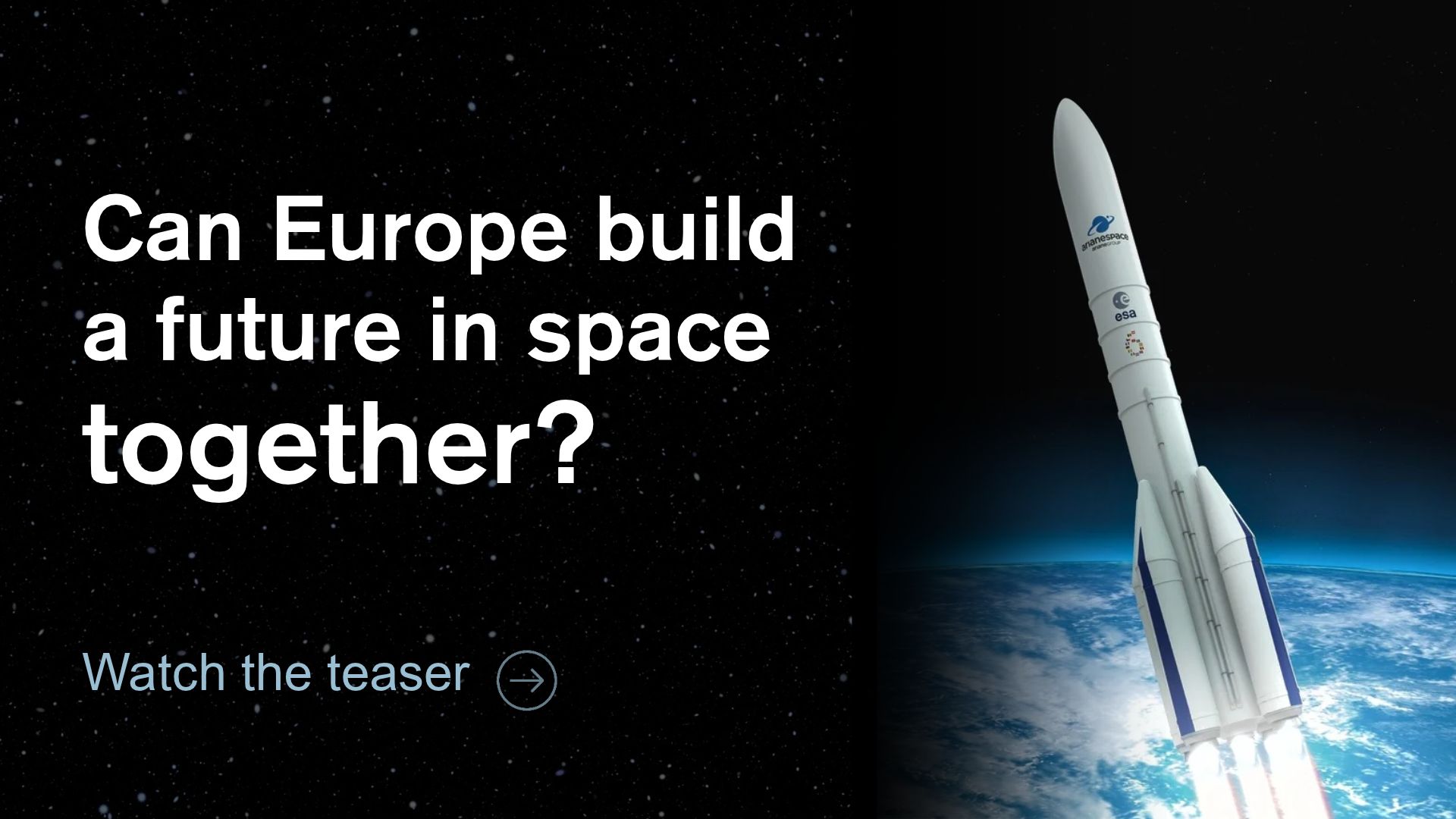
Thirteen European countries manufacture components for Ariane, which are shipped to Bremen, Germany, for assembly. The rocket is then loaded onto a specially designed ship and transported to Kourou, in French Guiana, home to Europe’s spaceport.
‘I found this journey of the rocket’s different components to be symbolic of the very meaning of European integration’, Klimburg-Witjes reflects. ’It is not built in Germany by German and French engineers alone, but by a lot of different manufacturers. It takes ten years to build a rocket. So, when you start building one, you have to know what kind of future you’re building it for, right? And to make this work, you have to agree on how to organise the process and trust each other. ESA member states also have to agree on the different iterations of Ariane. Ultimately, they need to have this shared idea of wanting a European rocket.’
From collaboration to competition
For a long time, Europe’s collaborative model for building rockets worked relatively well. But then SpaceX entered the picture.
‘Only then did Ariane start to seem kind of boring and too complex’, Klimburg-Witjes recalls. ‘And that changed how European space actors look at technology, at innovation, but also - and that was for me more interesting - at the different forms of integration and collaboration. SpaceX led to fragmentation.’
European governments increasingly turned to SpaceX rather than Ariane because it was cheaper. The company also introduced a different engineering approach.
‘Elon Musk had this saying: fail fast, learn faster. The idea was that even destroying things could be good for learning. ESA engineers have been trained in a completely different tradition. For them, it’s really about being reliable and precise. Also, ESA and Ariane use taxpayers’ money. So, you can’t just blow things up, right?’
In response to these developments, ESA introduced the European Launcher Challenge to get more start-ups in the launcher market. Yet this, too, intensified competition between member states.
‘Instead of building one rocket together, as was done before, it was about accelerating innovation. It was about competition. It was about startup culture. Companies such as Rocket Factory Augsburg and Isar Aerospace wanted to have new spaceports in different European countries. Germany, France, the UK, Italy, and Portugal all started building prototypes for smaller launchers that could eventually replace Ariane. The whole sector seemed to change under the new space paradigm.’
The militarisation of space
Recently, Ariane’s reputation has come full circle. Geopolitical instability has once again made the rocket strategically valuable, as Europe seeks to secure its own access to space.
‘The war in Ukraine made us realise how dependent we are on space and on having our own launchers’, Klimburg-Witjes says. ‘Cooperation with Russia stopped. Under the Trump administration, the US no longer seems quite so reliable. Some missions have been cancelled. Elon Musk even threatened to switch off the entire satellite system. Discussions about the need for our own sovereign launch capabilities have led to much more spending, to acceleration.’
She also observes how space and defence are becoming increasingly intertwined. Before the war in Ukraine, Ariane was primarily framed as a civilian launcher. Now, its dual-use nature and the military implications of European launch capabilities are increasingly part of the discussion, alongside France’s M51 nuclear missile programme.
‘At this point, we can really say space is militarised and increasingly weaponised. It is no longer this idealistic idea of space as a utopia, or some dreamy imagination. At a major conference in Brussels last year, a politician said space was not about science. You could hear people in the room reacting: Whoa, what?’
‘I think what he meant to say was that it is really about defence. It’s about the money. And yes, you can have some science missions, whatever.’
The Moon as Europe’s next space frontier
Europe’s space ambitions are increasingly reaching beyond Earth’s orbit. ‘You can see that the Moon has become very attractive for Europe, too’, says Klimburg-Witjes. Being able to launch European astronauts on a European rocket, to build a European moon base, all of that. [But] Ariane would need to be updated and adapted because you can’t fly astronauts on it.’
These ambitions raise questions about regulation, resources, territory and security.
‘Right now, there is no comprehensive regulatory framework governing what countries can do on the Moon. There is the Outer Space Treaty, which dates to the 1960s, when the world was very different, before Elon Musk and the commercial space race.’
The result is a host of unresolved questions. Could the first country to land on the Moon and build a base effectively claim a foothold there? What kinds of social and political orders might emerge? What values would shape these future societies – and whose values would they be? What kind of political system will they have? Will it be a democracy? What about security? What about immigration?
‘All the questions we struggle with here on Earth will also have to be addressed when we think about the Moon. And what role will Europe play in all of this, squeezed between the US and China? Europe now wants to be in the driver’s seat, and not just a passenger. This brings back the question of what it means to be European. What is a European astronaut? Will they be German or from another Member State, even if funded and trained by ESA? Or will we eventually call them a European astronaut?’
Ariana as a window into Europe’s future
It is not difficult to see how Ariane has become a ‘seismograph for European integration’ for Klimburg-Witjes and her team. Through discourse analysis, conference ethnographies, and conversations with policymakers and engineers, she traces how Ariane has been imagined, debated and redefined over time. She also invites those involved in Europe’s space programme to foresight workshops where they imagine different futures. These visions help her understand not only how Europe’s space ambitions are shaped, but also what kind of Europe they might help bring into being.
Whether Europe can build a shared future in space remains an open question, she says.
‘We see the rise of right-wing nationalist parties, which is never helping European integration. And you could also see that, for instance, Giorgia Meloni was working with Elon Musk to have an Italian satellite constellation, even though there’s currently one being developed as a European satellite constellation. So, I think the more nationalist politics, the less integration and more fragmentation we see in the space sector.’
Yet Klimburg-Witjes also sees the potential for space to bring Europe together.
‘I think these Moon plans, and Moon ideas and talk about establishing a European station on the Moon can also have a lot of symbolic value that can stimulate integration. But I think it really is a very crucial point in time now. Because to be part of this race, the race against the US, against Russia, Europe has to do that together. There is no other way. And I’m curious to see to what level this is going to work, because you can always have these disagreements between the member states. You have them in every European sector, not just in the space sector, right?’
‘But if they at some point really manage to build something together that is visible also to the public, I think that also makes a huge difference. For a long time, Europe’s presence in space was mainly about things like climate change and satellite monitoring, rather than being proud of a European rocket, a European astronaut, or a European Moon base. Perhaps Europe can use the current geopolitical instability as an opportunity to stand together a little more.’
Meanwhile, Ariane remains there as a historic document that also tells us something about the future.
‘It tells a lot about the decisions that haven’t been taken, about the ideals that maybe no one listened to, about the dreams of some engineers and the budget decisions that shape what the future rockets will look like. Looking at Ariane is going back to the past and looking to the future.’
Biography
Nina Klimburg-Witjes is an Associate Professor in the Department of Science and Technology Studies at the University of Vienna. Her research brings together Science and Technology Studies (STS), Social Studies of Outer Space and Critical Security Studies to explore how technological choices and political imaginaries shape Europe’s future beyond Earth. She co-founded the international Social Studies of Outer Space (SSOS) network and serves on the management committee of the COST Action 'Future-Oriented Governance of Outer Space'.
Project information