Biotechnology is increasingly important for Europe’s competitiveness, technological capabilities and economic growth. As the EU develops its policy framework for biotechnology and biomanufacturing, a new analysis from the European Research Council (ERC) highlights the scale and breadth of Europe’s existing frontier research base in the field.
The report draws in part on a survey of ERC biotechnology grantees conducted in May 2026. These researchers look ahead to major developments in their field and highlight the challenges of moving promising discoveries along the innovation pathway towards practical application.
A major European investment in biotechnology
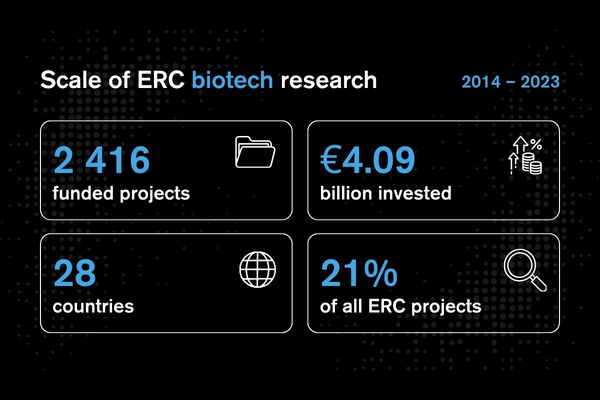
Between 2014 and 2023, the ERC awarded €4.09 billion in funding to biotechnology research, supporting 2 416 projects in 28 countries. These projects accounted for 21% of all ERC projects funded during this period.
Across the three main ERC scientific domains, biotechnology projects are predominately taken up in the Life Sciences (66.8%), while 32.7 % in Physical Sciences and Engineering and 0.5% in the Social Sciences and Humanities.
Medical biotechnology is the largest scientific area within ERC-funded biotechnology, with 1 448 projects. But the portfolio extends well beyond healthcare to include industrial biotechnology, agriculture and food, environmental biotechnology and blue biotechnology. Emerging fields covered by the portfolio include synthetic biology, bio-based technologies, engineered living materials, nanotechnology, miniaturisation and environmental monitoring.
From research towards innovation
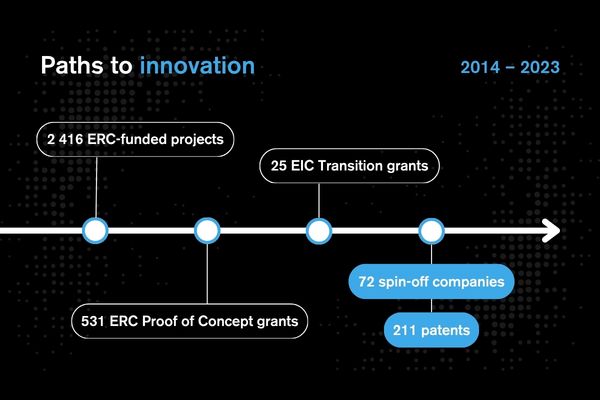
Some research results have gone beyond the research project towards further development and innovation. Between 2014 and 2023, biotechnology projects received 531 ERC Proof of Concept grants, representing 30 % of all such grants awarded during the period. Of these, 25 projects subsequently secured European Innovation Council (EIC) Transition grants. Within the portfolio, 211 researchers have filed patents, while 72 spin-off companies have been launched.
Importantly, the analysis also underlines a defining strength of frontier research: not every discovery needs an immediate application. Around 22% of projects remain far from practical use. By supporting curiosity-driven research, the ERC fosters new knowledge, methods and technologies whose applications may emerge only in the longer term.
The translation gap remains
The report also examines how the innovation pathway for promising biotechnology research could be strengthened, drawing primarily on the survey of ERC‑funded researchers. The survey, conducted among 388 ERC biotechnology grantees (a response rate of around 20%), identifies challenges in five key areas:
- support for frontier biotechnology research;
- funding gaps between early‑stage discovery and ERC Proof of Concept grants;
- commercialisation and scale‑up;
- stronger innovation ecosystems; and
- governance and policy frameworks.
Technologies shaping biotechnology by 2030
The report further explores which emerging technologies ERC biotechnology researchers expect to have the greatest impact on the sector by 2030. Respondents highlight:
- AI-enabled life-science data mining (85 %),
- mRNA vaccines (82%),
- omics technologies (78 %),
- tissue engineering (77 %) and
- CRISPR-Cas (76 %).
Other technologies mentioned include CAR-based therapies, engineered living materials and synthetic cells, and pluripotent stem cells.
These expectations point to a rapidly evolving research landscape in which biology increasingly intersects with artificial intelligence, data, engineering and materials science. That many of these advances do not yet have clear applications underscores the need for continued support for curiosity‑driven fundamental research in biotechnology.