What access to technology feels like

By Inge Ruigrok
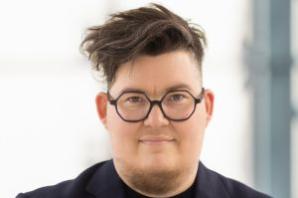
Human-computer interaction (HCI) looks at what happens between people and technology: how we use it, experience it and make sense of it. But Katta Spiel is interested in what happens before that interaction even begins. ‘There has been lots of investigation into how we experience technologies’, Spiel says. ‘But there is less on how we get to that experience - what comes beforehand - even though that highly influences it.’ That ‘beforehand’ can be exhilarating (‘Yes, I achieved that now, and it was so hard’) or bleak (‘That was not worth all the work’). Spiel’s ERC-funded project, ACCESSTECH, aims to understand access as an experience in its own right, especially for disabled people navigating different technologies and contexts.
A team of disabled experts
A defining feature is that the team itself is made up of disabled researchers. ‘That was not necessarily a requirement, but it turned out that way,’ Spiel says. ‘I am disabled, and when I wrote the project there were certain people I had in mind already, and those are also disabled.’ Beyond the core team, the project works extensively with participatory formats, shifting from ‘users’ who are studied, to experts who co-shape knowledge.
One example is a ‘participatory risk assessment’ led by team member Felix Fussenegger with wheelchair users who go outdoors. Rather than treating risk only as a matter of care, the method recognises risk-taking as part of dignity: disabled people, like everyone else, may choose to take risks, but want to do so on a well-informed basis. To support that, four or five disabled experts shared strategies and experiences, then co-defined criteria for when to proceed, adapt or turn back. ‘Part of that is simply giving people who are often excluded from academia the place to share their knowledge and be involved,’ Spiel says.
Three technological contexts – and a pivot
The project examines access across three technological contexts. The first explores social networks and information-seeking for wheelchair users who want to explore nature. The team’s initial assumption, that people need information first, has been confirmed, but with a nuance: quality and trust matter more than the sheer amount of information. Wheelchair users trust other wheelchair users’ reports far more than generic claims that ‘something is accessible or not, because the information’s granularity is different, which makes it easier for them to relate ‘, Spiel explains.
That insight pushed the team beyond one-off studies towards sustainable platforms. They are now collaborating with Austria’s Alpine Club to explore how to update high-quality, nuanced accessibility information over time.
The second context examines different ways of experiencing the world socially, and what role technologies play in achieving desired ways to be in community with others. Here, technology need not be digital or electric. In interviews with neurodivergent participants negotiating intimacy and closeness, the ‘tools’ people used to explore and communicate their boundaries ranged from a small stone they could hold during difficult conversations, to an Excel sheet for tracking comfort levels and triggers, to a simple written document outlining preferences and limits.
‘The important thing was to create things that are open for appropriation,’ Spiel says. The team has identified design characteristics for such embodied technologies and is presenting part of this work through an art exhibition. Team members Ekat Osipova and Oliver Jayden Suchanek collaborated across work packages to put perspectives from different experiences of disability into the conversation.
The third context originally proposed virtual reality but that changed after the public release of generative AI in late 2022. ‘That was something I couldn’t have foreseen when writing the proposal,’ Spiel says. Surveys and interviews with deaf participants revealed that large language models have become a practical access tool. ‘People keep telling us the same thing: I can just ask and ask and ask, and it will always answer and never get tired of my questions.’ Others value not having to wait for an interpreter to proofread a CV or adjust language for a hearing-dominated world.
This sparked a long discussion in the team. Spiel is critical of generative AI’s underlying assumptions - no semantic understanding, only mathematical prediction - and worried about shifting dependency from humans to machines that cannot be held accountable. Within the team, Robin Angelini, the deaf lead of the project, countered that the lived advantages are real. Together they landed on a sharper critique: the core problem is not human versus machine dependency, but that deaf people are expected to function in a hearing world like a hearing person. ‘If you don’t follow the ideals that are put on hearing people, then it’s basically put on you and ingrained as your failure,’ Spiel says. ‘That is a main problem that that shift won’t solve in any way.’
‘Access is bittersweet’
A collective autoethnography - stories written by the disabled researchers about what ‘access’ means to them - challenged Spiel’s own assumptions. ‘When I conceptualised this, I saw access as a net good,’ they say. ‘What I realised through these stories is that access is a difficult concept. Once you’re actively reflecting on it, once it’s an issue, once it’s present as a matter, it is immediately because something is lacking. Access comes with a lack of access. If access is sweet, then it’s always bittersweet, so to speak.’
That reframing has methodological consequences. ‘We need to understand what [access] means to lay the foundation to then lead into how we might have to change our assumptions of how we even talk and measure experiences,’ Spiel says. In their field, technology is a little overrated. ‘It can help facilitate access; it can hinder, delay or prohibit it. It can be completely meaningless if it is not accessible - or not needed.’ Being open to technology not being important is, paradoxically, what will help identify what truly matters.
The team is wary of ‘disability dongles’: solutions in search of a problem, like yet another signing glove that misunderstands sign language and that nobody asked for. ‘People are asking for very different things when it comes to access,’ Spiel says. Sometimes they are not asking for interpreters at all, but for hearing people to learn sign language, or for deaf people to get education in sign languages so they can build their own ecosystems. That is not something technology can fix.’
Lived experience as expertise
Interdisciplinarity is built into ACCESSTECH: computer science, design, cultural studies, linguistics and psychology all speak to each other. Spiel’s own neurodivergence and intersex identity inform the research - and the daily practice of doing it. During their PhD, they hit a wall trying to conform to expected work patterns. Their advisor responded by giving them an additional small project, allowing them to switch between tasks. In meetings with poor acoustics and no captions, Spiel knits to stay focused.
Their experiences of institutional exclusion are more direct, too. After receiving legal recognition as non-binary/intersex, they recall struggling with grant forms that offered only male/female. ‘I had to tick one and then write a whole letter explaining why the gender I crossed was wrong… Do you make men do that?’
Coming out publicly was partly practical (‘it’s so much effort to shave every day’), partly principled. A therapist’s remark – ‘I don’t see the point in people trying to change the world to fit something they think is happening, instead of accepting the reality that is happening’- made them realise they were expending energy to conform to an imagined reality that simply wasn’t the case. ‘That sentence made me realise that I’m doing a whole lot of work to make a reality happen that was already true… I shouldn’t have to do that.’
Visibility can be both powerful and exhausting. As chair of Austria’s UN disability-rights monitoring committee, Spiel meets ministers who must engage with an openly intersex expert in a formal setting. ‘It’s really cool that they kind of have to think about this now.’ At the same time, they are aware of rising far-right politics in Europe and what that could mean for an intersex professor with EU funding. ‘I was wondering… would the whole team just crumble into pieces?’ They cope by focusing on the spaces they can shape. ‘You create the living space that you want, and within those spaces it’s fine.’
Mentorship as legacy
For Spiel, one of ‘the best things about all of this’ is mentorship. ‘I mean, who gets the chance to create a space and then see others carry forward the solidarity that you strive for? At least half here are queer, and I have three non-binary students. Younger generations feel safer disclosing their identity and are more open about being non-binary. I love this for them.’
A near-fatal reaction to painkillers at 23 - agranulocytosis leading to sepsis - left Spiel with a lasting sense that life is a gift to be spent without regret. ‘I choose carefully, which makes me principled in ways that can be uncomfortable for some people. Don’t be so driven… You don’t have to overwork yourself… Be more modest about what you know and what you don’t know.’ Some lessons, they recognise, can only be learned through experience. ’You have to give yourself that time.’
In ACCESSTECH, that patience shows up as a commitment to foundational work: rethinking access, re-centring disabled expertise, and designing technologies that are not just usable, but desired. ‘We are striving for a fundamental paradigm shift in the way we approach disabilities and technologies,’ Spiel says.
Biography
Katta Spiel is Assistant Professor for Critical Access in Embodied Computing at TU Wien Informatics. They earned a PhD in Human–Computer Interaction from TU Wien (2018), recognised with the ACM SIGCHI Outstanding Dissertation Award (2020), and have previously held a FWF Hertha-Firnberg fellowship and a postdoctoral position at KU Leuven. Trained in computer science, media systems and cultural studies at Bauhaus-Universität Weimar, they also teach in Gender Studies at the University of Vienna and engage in sign-language interpreting and disability-rights monitoring.
Project information