
Tags
Displaying 1871 - 1880 of 2748
Microrobotics meets nanomedicine for improved eye surgery
With an aging population, Europe sees a rapid increase in the number of people affected by visual disorders requiring surgical intervention. Funded by the ERC, a team of scientists based in Zürich are currently designing innovative microrobotics…
With an aging population, Europe sees a rapid increase in the number of people affected by visual disorders requiring surgical intervention. Funded by the ERC, a team of scientists…
With an aging population, Europe sees a rapid increase in the number of people affected by visual disorders requiring surgical intervention. Funded…
With an aging population, Europe sees a rapid increase in the number of people affected by visual disorders requiring surgical intervention. Funded by the ERC, a team of…
With an aging population, Europe sees a rapid increase in the number of people affected by visual disorders requiring…
A step forward to the service robots of the future
Why should people waste their time executing some repetitive time-consuming everyday tasks which do not require creativity and intellectual capacity? Such a reasoning stands behind Professor Bruno Siciliano’s ERC funded project aiming at the…
Why should people waste their time executing some repetitive time-consuming everyday tasks which do not require creativity and intellectual capacity? Such a reasoning stands behind…
Why should people waste their time executing some repetitive time-consuming everyday tasks which do not require creativity and intellectual capacity?…
Why should people waste their time executing some repetitive time-consuming everyday tasks which do not require creativity and intellectual capacity? Such a reasoning stands…
Why should people waste their time executing some repetitive time-consuming everyday tasks which do not require creativity…
Flocking drones, swarming pigeons
Not only living organisms, but also robots can move in certain collective patterns. But what rules underlie such behaviour? The study of the patterns of group motion in pigeons motivated Professor Tamás Vicsek to develop a swarm of drones being able…
Not only living organisms, but also robots can move in certain collective patterns. But what rules underlie such behaviour? The study of the patterns of group motion in pigeons…
Not only living organisms, but also robots can move in certain collective patterns. But what rules underlie such behaviour? The study of the patterns…
Not only living organisms, but also robots can move in certain collective patterns. But what rules underlie such behaviour? The study of the patterns of group motion in…
Not only living organisms, but also robots can move in certain collective patterns. But what rules underlie such behaviour?…
Broken hearts may be repaired
Prof. Michael Schneider is a leading authority in the field of cardiac molecular biology. In 2008, he obtained an ERC grant to identify the mechanisms governing self-renewal of cardiac progenitor cells, a population of stem cells located in the…
Prof. Michael Schneider is a leading authority in the field of cardiac molecular biology. In 2008, he obtained an ERC grant to identify the mechanisms governing self-renewal of cardiac…
Prof. Michael Schneider is a leading authority in the field of cardiac molecular biology. In 2008, he obtained an ERC grant to identify the…
Prof. Michael Schneider is a leading authority in the field of cardiac molecular biology. In 2008, he obtained an ERC grant to identify the mechanisms governing self-renewal…
Prof. Michael Schneider is a leading authority in the field of cardiac molecular biology. In 2008, he obtained an ERC grant…
Geometry at the service of robotics
Embodied intelligence is a very dynamic research field. With this ERC project, Doctor Jean-Paul Laumond intends to contribute to the advancement of basic research in this field bridging the gap between robot engineering and neuroscience thanks to…
Embodied intelligence is a very dynamic research field. With this ERC project, Doctor Jean-Paul Laumond intends to contribute to the advancement of basic research in this field…
Embodied intelligence is a very dynamic research field. With this ERC project, Doctor Jean-Paul Laumond intends to contribute to the advancement of…
Embodied intelligence is a very dynamic research field. With this ERC project, Doctor Jean-Paul Laumond intends to contribute to the advancement of basic research in this…
Embodied intelligence is a very dynamic research field. With this ERC project, Doctor Jean-Paul Laumond intends to…
Spotlight on ERC Projects: Robotics
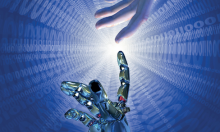
The idea of automated machines that can perform tasks
autonomously dates back to ancient times but robotics is a relatively
new research domain – less than 60 years old. Today, this broad,
interdisciplinary scientific field combines mechanical and electrical
engineering, computational studies, communication engineering,
but also neurosciences and cognitive sciences.
From the big industrial robots that assist production in factories, to
the robotic sensors in navigation systems and the nanorobots that
might be injected in our cells for therapeutic purposes, researchers
in robotics do not have to look too far for a scientific challenge or
room for progress.
The European Research Council (ERC) aims at supporting top
researchers with these challenges by funding their best scientific
ideas. Around 60 robotics-related projects have been funded by
the ERC since its creation, representing more than €104 million
invested in research areas such as human-robot interactions, robot
tasks and abilities with various industrial or service applications
(e.g. health, care, safety and domestic).
This brochure showcases a few examples of these projects.
Spotlight on ERC Projects: Robotics
(text/html, 325.55 KB)
How to equip robots with senses
Compared to humans, the sensing and dexterity of current robots is extremely limited. Reproducing these fundamental human abilities in robotics systems requires a new scientific and technological approach, according to Professor Danica Kragic.
Compared to humans, the sensing and dexterity of current robots is extremely limited. Reproducing these fundamental human abilities in robotics systems requires a new scientific and…
Compared to humans, the sensing and dexterity of current robots is extremely limited. Reproducing these fundamental human abilities in robotics…
Compared to humans, the sensing and dexterity of current robots is extremely limited. Reproducing these fundamental human abilities in robotics systems requires a new…
Compared to humans, the sensing and dexterity of current robots is extremely limited. Reproducing these fundamental human…